Choosing a new dishwasher can feel like navigating a complex maze of features, brands, and specifications. But did you know that one of the most fundamental distinctions lies in whether a model adheres to European or American design philosophies? These two approaches stem from different cultural priorities, kitchen aesthetics, and utility standards, resulting in dishwashers that, while serving the same purpose, offer very distinct experiences. Understanding these core differences is essential for making an informed decision that perfectly aligns with your household’s needs and kitchen style.
Key Differences Between European and American Dishwashers
The variations between European and American dishwasher models span several crucial aspects, from how they integrate into your kitchen to their operational efficiency and cleaning mechanisms. Let’s delve into what sets them apart.
Dimensions and Aesthetic Integration
|
Our Picks for the Best Dishwasher in 2026
As an Amazon Associate I earn from qualifying purchases.
|
||
| Num | Product | Action |
|---|---|---|
| 1 | COMFEE’ Countertop Dishwasher, Energy Star Portable Dishwasher, 6 Place Settings & 8 Washing Programs, Speed, Baby-Care, ECO& Glass, Dish Washer for Dorm, RV& Apartment, Black |

|
| 2 | Cascade Complete Dishwasher Pods - Fresh Scent ActionPacs, Dishwasher Detergent, Dishwasher Soap, Detergent Pods, 78 Count |
|
| 3 | COMFEE’ Portable Mini Dishwasher, Energy Star, Countertop, 6 Place Settings, with 8 Washing Programs, Speed, Baby-Care, ECO& Glass, Dish Washer for Dorm, RV& Apartment, White |
|
| 4 | Cascade Platinum Plus Dishwasher Pods, Dish Detergent Soap, Clean Scent, 62 Count |
|
| 5 | Kenmore 24" Premium Hybrid Tub Dishwasher - UltraWash, MoreSpace Adjustable Rack, High Temp & SmartWash - 12 Place Settings - 54 DBA - ENERGY STAR Certified - Fingerprint Resistant Stainless Steel |
|
| 6 | Honeywell 18 Inch Dishwasher with 8 Place settings, 6 Washing Programs, Stainless Steel Tub, UL/Energy Star- Black |
|
| 7 | BLUELAND 100% Plastic-Free Dishwasher Detergent Tablets, 60 Count, Free & Clear, Eco-Friendly Dishwashing Pods, Natural, USDA Certified biobased |
|
| 8 | Cascade Complete Dishwasher Detergent Liquid Gel, Dish Detergent, Dishwasher Soap, Citrus, 75oz |
|
| 9 | EUHOMY Countertop Dishwasher Portable with 6 Programs, 5L Built-in Water Tank for Apartments & RV, 167℉ High-Temp, No Hookup Needed, Mini Dishwasher with Baby Care, Air Dry/Quick/ECO/Fruit/Normal Mode |
|
| 10 | Sharp SDW6504MS Stainless Steel Dishwasher, 24-inch Pocket Handle, 52 dB, Hybrid Tub, 12 Place Settings, 5 Cycles, Heated Dry |
|
One of the most immediate and noticeable differences is in their physical dimensions and how they fit within your kitchen cabinetry.
European dishwashers are engineered for a seamless, integrated look. They are typically designed to sit flush with standard kitchen cabinets, often having a shallower depth (around 21.75 to 23.75 inches, or 55-60 cm) to achieve this streamlined aesthetic. This design is highly favored in modern kitchens and open-concept living spaces where a cohesive visual flow is paramount. Many European models are also “panel-ready,” allowing you to attach a custom cabinet panel to match your existing kitchen design, making the appliance virtually disappear.
In contrast, American dishwashers are generally deeper, often protruding about ¾ to 1 inch beyond standard 24-inch cabinetry, reaching depths of 25 to 26 inches. This extra depth often translates to a slightly larger interior capacity. While some American models offer a more integrated look, many have a more traditional stance, designed to be a visible appliance in the kitchen layout. This can offer a more robust or professional aesthetic, depending on the chosen finish and handle style.
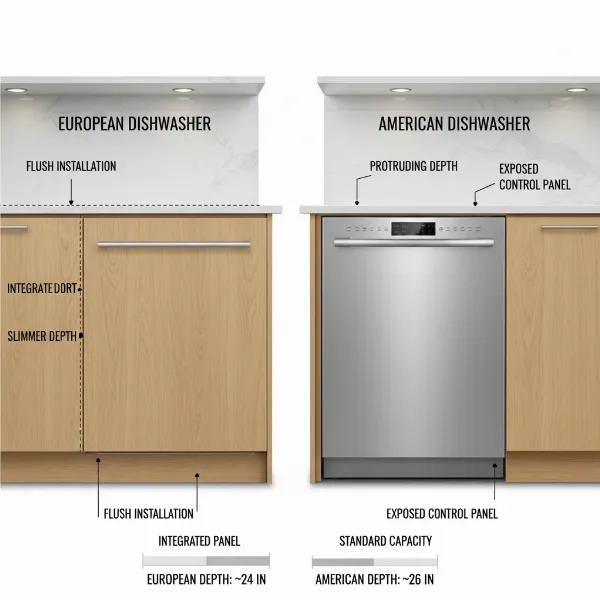 A side-by-side comparison illustrating the typical dimensions and flush versus protruding installation of European and American dishwashers in a kitchen setting.
Drying Technology
The method by which dishes are dried is another significant differentiator, impacting energy consumption and final results.
European dishwashers predominantly utilize condensation drying. After the hot wash cycle, the dishwasher does not employ a heating element to dry the dishes. Instead, the residual heat from the final rinse causes moisture on the dishes to evaporate. This moist air then condenses on the cooler stainless steel interior walls of the dishwasher, eventually draining away. This method is highly energy-efficient and gentler on delicate items and plastics, preventing warping or melting. However, it can take longer and sometimes leave plastics or certain dishware slightly damp, which may require a short air-dry once the cycle is complete. Higher-end European models, such as those with Bosch’s CrystalDry technology, use minerals like zeolite to absorb moisture and release heat, achieving a more complete dry even for plastics.
American dishwashers traditionally employ a heated dry system. This method uses an exposed heating element at the bottom of the tub to actively heat the air, accelerating the drying process. Dishes typically emerge hotter and significantly drier, often with a shorter cycle time. While effective, this method consumes more energy and can potentially melt or warp certain plastic items if not placed carefully on the top rack. Modern American dishwashers are evolving, with some models incorporating advanced drying cycles that balance speed with energy efficiency, often featuring sensor-based drying.
Water and Energy Efficiency
Environmental considerations and utility costs play a crucial role in dishwasher design.
European dishwashers are renowned for their superior water and energy efficiency. Driven by stricter environmental regulations and higher utility costs in Europe, these machines are engineered to use significantly less water per cycle. For instance, many modern European dishwashers use less than 10 liters of water per cycle, a notable reduction from previous models that used around 20 liters. This efficiency is achieved through sophisticated sensor technology, optimized spray patterns, and longer wash cycles that allow detergents more time to work, reducing the need for excessive water volume or high temperatures.
American dishwashers, while continually improving in efficiency (many are ENERGY STAR certified), have historically used more water and energy per cycle, prioritizing powerful cleaning and faster drying. The emphasis has traditionally been on quick, robust cleaning, often utilizing higher wash temperatures and more powerful jets. However, as global standards converge, newer American models are incorporating advanced efficiency features, though they still might not match the ultra-low water consumption of their European counterparts.
Noise Levels and Filtration Systems
The operational sound of a dishwasher can be a major factor, especially in homes with open floor plans.
European dishwashers are typically quieter in operation. This is largely due to their design, which often eschews a noisy hard food disposer (macerator) in favor of a manual filter system. This filter traps food particles, which then needs to be regularly removed and cleaned by the user. The absence of a grinding macerator, combined with superior insulation and sealed bottoms that enclose the pump and motor, contributes to significantly lower decibel levels, making them barely audible during a cycle.
American dishwashers more frequently incorporate a hard food disposer or macerator. This component grinds down larger food particles, eliminating the need for pre-rinsing and manual filter cleaning. While convenient, the macerator operation can be noticeably louder. However, many premium American models now feature enhanced insulation and quieter motors, significantly reducing their noise output to competitive levels, sometimes as low as 39 dB.
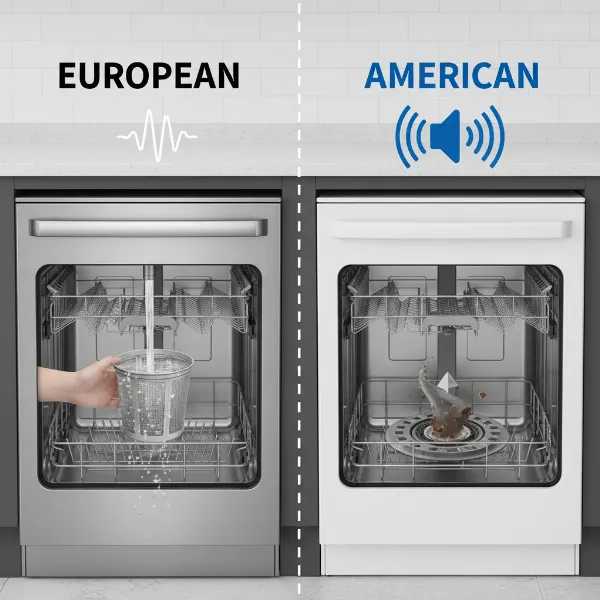 Illustrating the noise difference and filtration systems of European vs American dishwashers, showing a quiet operation and filter basket versus a noisier disposer.
Interior Design and Capacity
How dishes are loaded and the overall capacity also differ between the two styles.
European dishwashers often feature highly flexible interior designs, including adjustable racks, fold-down tines, and dedicated third racks for cutlery and small items. This versatility allows users to customize the loading space for various dishware, maximizing the number of place settings despite generally smaller overall dimensions. The emphasis is on smart space utilization and organization.
American dishwashers tend to have a more traditional rack layout with two or three robust racks. They often boast a larger volumetric capacity, designed to accommodate bigger pots, pans, and serving dishes common in American meal preparation. While some American models now include adjustable racks and third racks, the primary focus has historically been on straightforward loading and accommodating larger items.
Wash Cycles and Features
Both types of dishwashers offer a range of wash cycles, but with different priorities.
European dishwashers often provide specialized wash cycles tailored for specific types of dishware, such as delicate glass cycles or intensive programs for heavily soiled pots. They might also integrate water softeners directly into the appliance, which is particularly beneficial in regions with hard water to prevent mineral deposits and enhance cleaning performance. Their cycles tend to be longer due to lower water usage and condensation drying.
American dishwashers typically feature more robust wash options with higher wash temperatures, aiming for powerful and speedy cleaning. Cycles are often shorter and focus on broad cleaning capabilities rather than ultra-specialized programs, prioritizing convenience and a quicker turnaround for dishes.
Controls and User Interface
The aesthetic approach extends to the control panel as well.
European dishwashers frequently feature hidden or minimalist controls, often located on the top edge of the door, visible only when the door is ajar. This contributes to the sleek, integrated look, ensuring the dishwasher’s exterior remains clean and uncluttered. Touch controls and discreet displays are common.
American dishwashers often have more prominent control panels on the front of the door, with visible buttons and digital displays. This design prioritizes accessibility and clear indication of cycle status, reflecting a preference for straightforward user interaction.
Comparative Overview: European vs. American Dishwashers
| Feature | European Dishwashers | American Dishwashers |
|---|---|---|
| Aesthetic/Fit | Sits flush with cabinetry; minimalist, integrated look | Often protrudes slightly; more traditional appliance look |
| Depth | ~21.75-23.75 inches (55-60 cm) | ~25-26 inches |
| Drying Method | Condensation drying (energy-efficient, plastics-safe, can leave damp spots) | Heated dry (faster, more thorough dry, higher energy, potential plastic warping) |
| Water Usage | Very low (e.g., <10 liters/cycle), highly efficient | Moderate (e.g., ~11-22 liters/cycle), improving efficiency |
| Energy Efficiency | High | Moderate to High (many ENERGY STAR certified) |
| Noise Level | Generally quieter (filter system, better insulation) | Can be louder (hard food disposer), but improving |
| Filtration | Manual filter system (requires cleaning) | Hard food disposer (grinds food, no pre-rinsing needed) |
| Rack System | Highly flexible, adjustable, often includes third racks | Traditional, robust, focused on larger capacity |
| Wash Cycles | Longer, specialized, lower temperatures | Shorter, powerful, higher temperatures |
| Additional Features | Often include integrated water softeners | Fewer integrated water softeners |
| Control Panel | Hidden or minimalist (top of door) | Front-facing, visible controls |
Choosing the Right Dishwasher: Key Considerations
Selecting the ideal dishwasher boils down to evaluating your specific needs and priorities.
Kitchen Design and Space: Do you desire a seamless, built-in look that blends with your cabinetry, or is a visible appliance acceptable? Measure your cabinet depth carefully to ensure a flush fit for European models.
Budget: While there’s overlap, entry-level European models can sometimes offer excellent value for their quietness and efficiency, whereas premium features are available across both categories.
Personal Priorities:
- Quietness: If an open-concept living space or noise sensitivity is a concern, European models tend to excel.
- Drying Performance: For perfectly dry dishes, especially plastics, a heated dry system (common in American models) might be preferred, though advanced European options exist.
- Efficiency: If reducing water and energy consumption is a top priority, European models are generally leaders.
- Capacity: For large families or frequent entertaining, the greater capacity of some American models might be more beneficial.
Water Hardness: If you live in an area with hard water, a European model with an integrated water softener could significantly improve cleaning results and reduce spotting.
Top Brands: A Glimpse
When considering these two design philosophies, certain brands epitomize each style.
Bosch: A prime example of European engineering, Bosch dishwashers are renowned for their ultra-quiet operation, sleek integrated designs, and exceptional water and energy efficiency. They often feature flexible third racks and advanced drying technologies like CrystalDry.
KitchenAid: Representing the American approach, KitchenAid dishwashers are known for their powerful cleaning performance, robust construction, and effective heated drying systems. They often feature a more traditional, high-end aesthetic with customizable handle options.
Usage and Maintenance Tips
Regardless of whether you choose a European or American model, proper usage and maintenance are key to extending your dishwasher’s lifespan and ensuring optimal performance.
- Load Effectively: Avoid overcrowding and ensure spray arms are not obstructed.
- Detergent Choice: Use high-quality detergent and rinse aid, especially with condensation drying models, to aid in spot-free drying.
- Filter Maintenance: If you have a European model with a manual filter, clean it regularly (e.g., weekly or bi-weekly) to prevent odor and ensure effective cleaning.
- Scrape, Don’t Rinse: For most modern dishwashers, simply scraping off large food particles is sufficient. Pre-rinsing can sometimes hinder detergent effectiveness designed to activate with food soil.
- Run Full Loads: Maximize efficiency by running the dishwasher only when it’s fully loaded.
Buying Guide Summary
To choose your ideal dishwasher, first, consider your kitchen’s dimensions and how you want the appliance to integrate visually. Next, prioritize what matters most to you: quietness, drying power, water/energy savings, or raw capacity. Explore brands known for excelling in your preferred categories, and always review the specific features of individual models. Finally, don’t forget to factor in long-term operating costs and maintenance requirements.
Conclusion
The choice between a European and American dishwasher model isn’t just about origin; it’s about choosing a design philosophy that best fits your lifestyle, kitchen aesthetics, and environmental values. European models excel in quietness, energy efficiency, and seamless integration, often featuring sophisticated condensation drying and flexible interiors. American models frequently offer robust cleaning, powerful heated drying, and larger capacities, with a more traditional kitchen presence. Both types offer excellent cleaning capabilities, but their distinct approaches cater to different preferences.
Which dishwasher design best speaks to your kitchen’s needs and your daily routine?
Frequently Asked Questions
What is condensation drying in a dishwasher?
Condensation drying is a method used primarily by European dishwashers where dishes dry using residual heat from the wash cycle. Moisture condenses on the cooler stainless steel tub walls and drains away. It’s energy-efficient and gentle on plastics but may leave some items damp.
Are European dishwashers quieter than American ones?
Generally, yes. European dishwashers are often quieter because they typically use a filter system instead of a noisy hard food disposer and feature superior insulation, contributing to a significant reduction in operational sound.
Do European dishwashers use less water?
Absolutely. European dishwashers are engineered for high water efficiency, often using significantly less water per cycle compared to traditional American models, driven by stricter environmental standards.
Can I install a European dishwasher in an American kitchen?
Yes, you can. While European models are designed to fit flush, their standard width is often comparable. However, always check the exact dimensions and installation requirements to ensure compatibility with your existing cabinetry and utility hookups.
Why do European dishwashers have longer cycle times?
European dishwashers often have longer cycle times due to their emphasis on water and energy efficiency. They use lower temperatures and less water, requiring more time for detergents to work effectively and for the condensation drying process to complete.
What is a third rack in a dishwasher?
A third rack is an additional shallow rack, often found in European dishwasher models, located at the very top of the dishwasher tub. It’s designed to hold cutlery, spatulas, and other small, flat items, freeing up space in the main racks.